D-MORPH: decentralised self-organising multi-robot task allocation via neuroplasticity-inspired adaptive topology
Xuezhi Niu and Didem Gürdür Broo · code: README · all numbers: results.md
Each robot in a heterogeneous team keeps its own directed partner preferences and links and updates them online with four plasticity rules (synaptic, homeostatic, structural and metaplastic) from its own observations: its target, the robot it is co-assigned with, and the completion of their joint mission. D-MORPH needs no task model, no bid computation, no message exchange and no offline training. It is evaluated on the TA-RWARE robotic warehouse with 8 to 24 robots.
Supplementary Videos 1–4
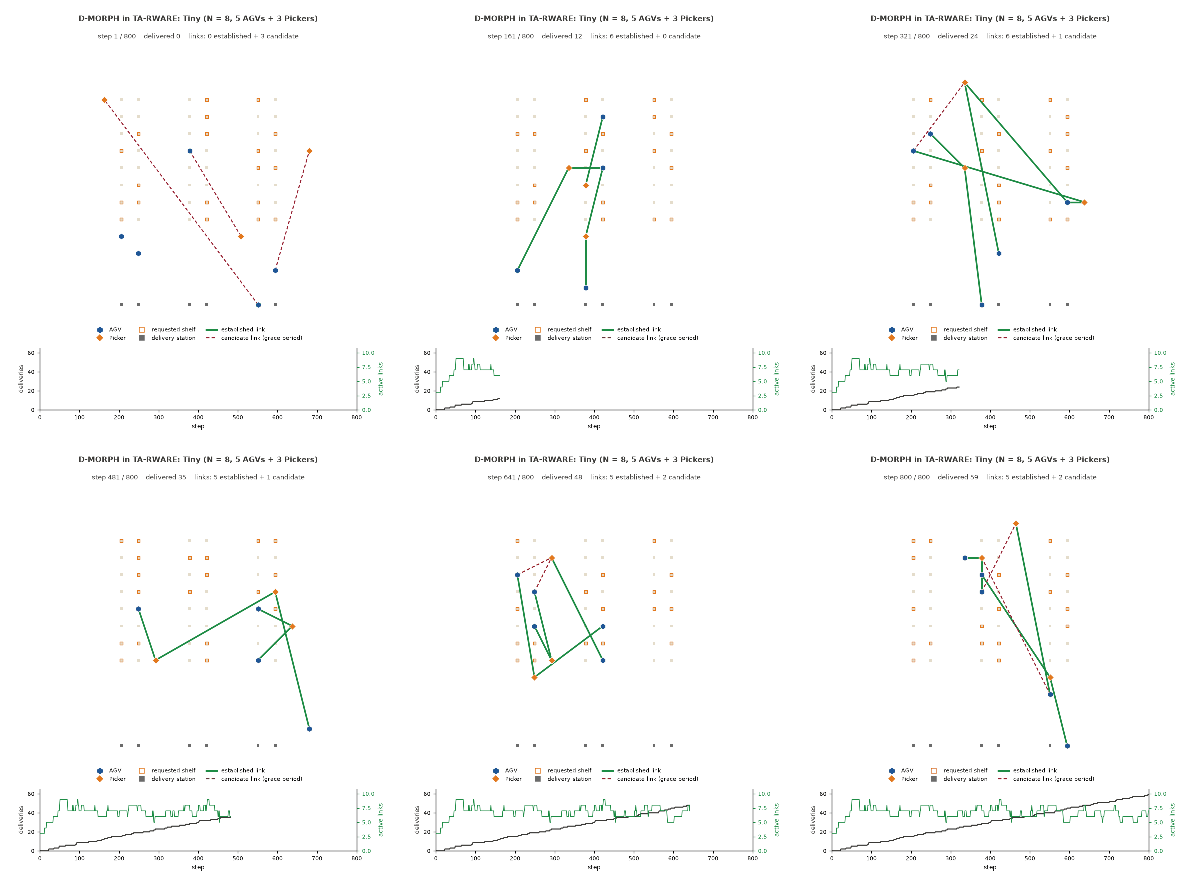
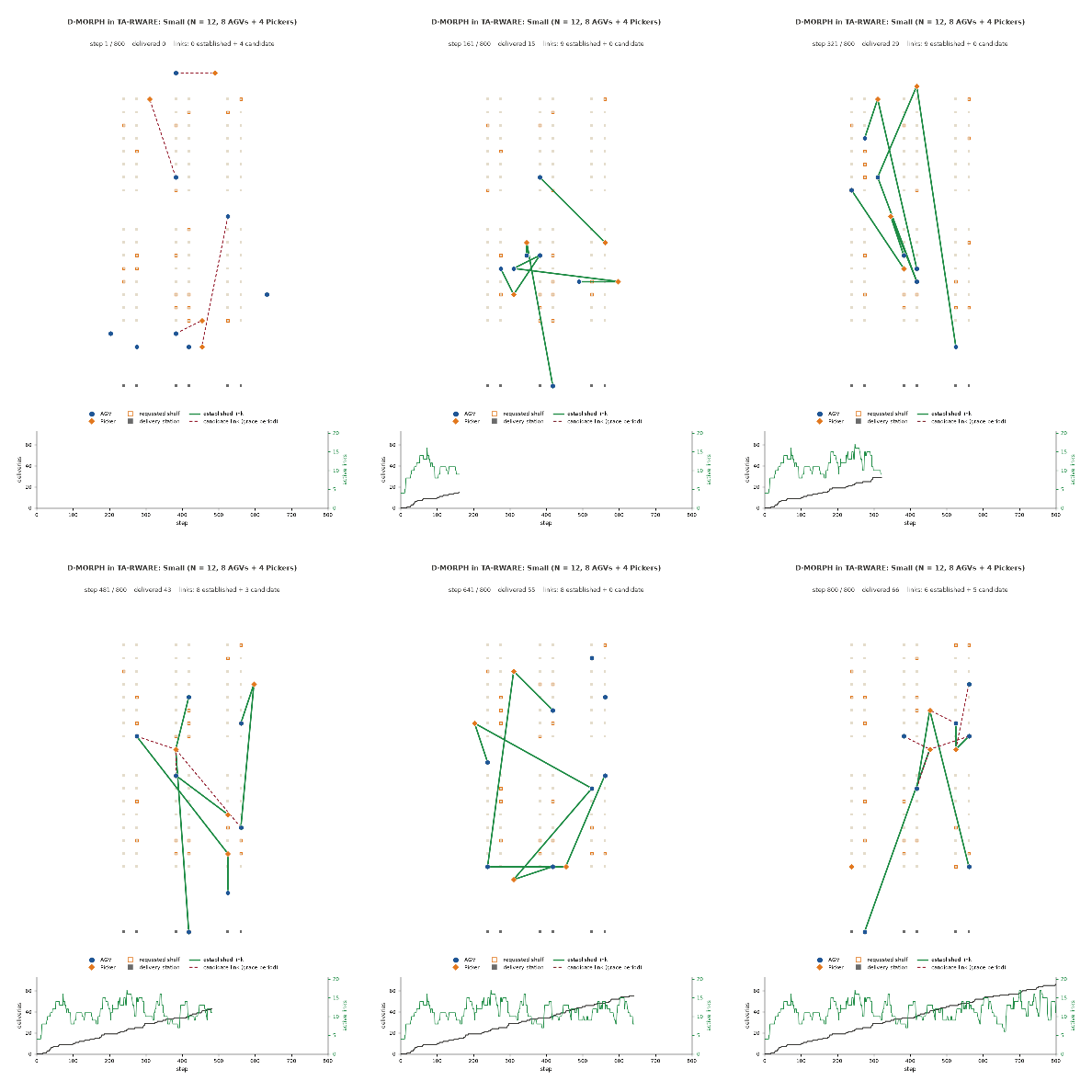
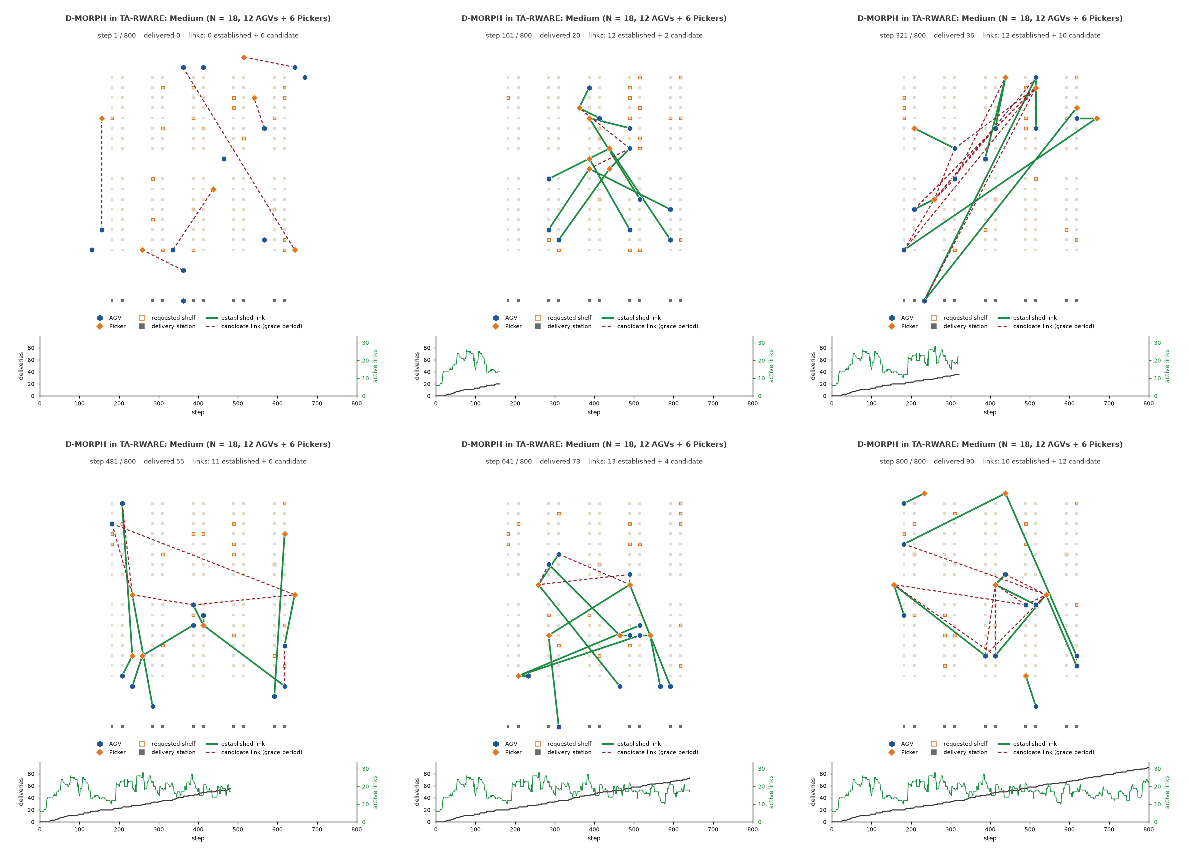
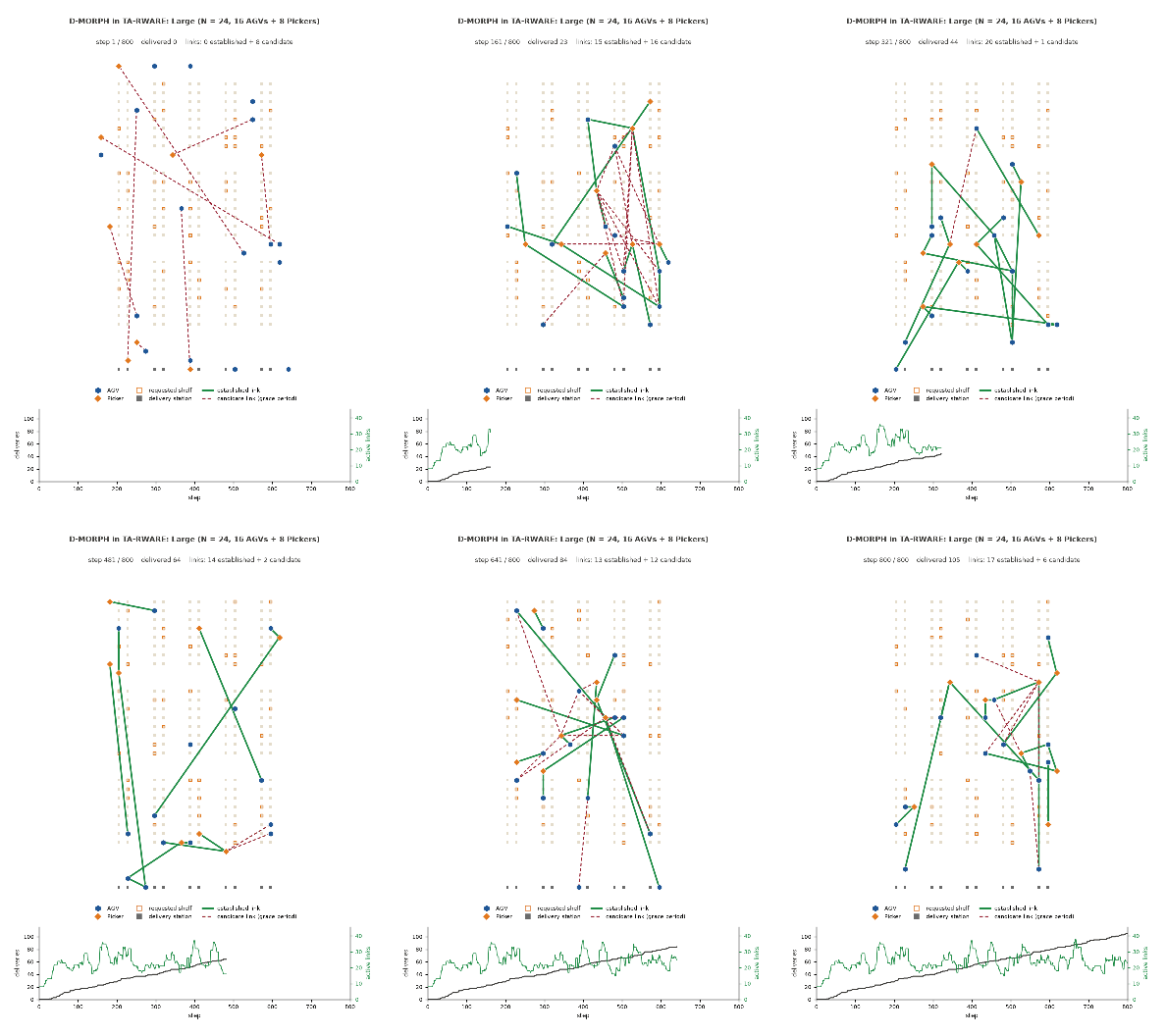
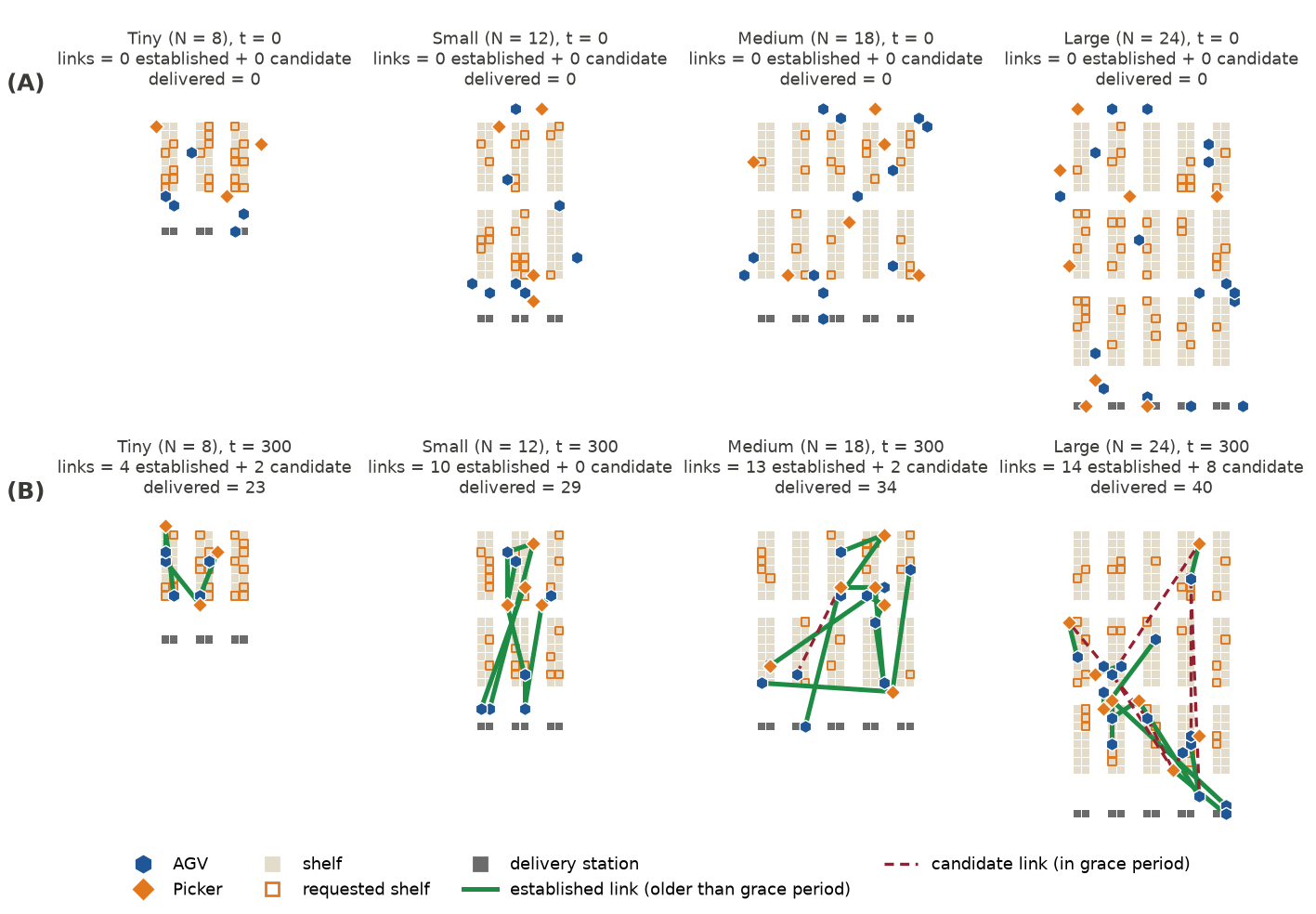
One episode (800 steps, seed 42) at each fleet size. Blue hexagons: AGVs; orange diamonds: Pickers; orange outlines: requested shelves; grey squares at the bottom: delivery stations. Green lines are established links (older than the 20-step grace period); red dashed lines are candidate links. The strip below shows cumulative deliveries and active links.
Method
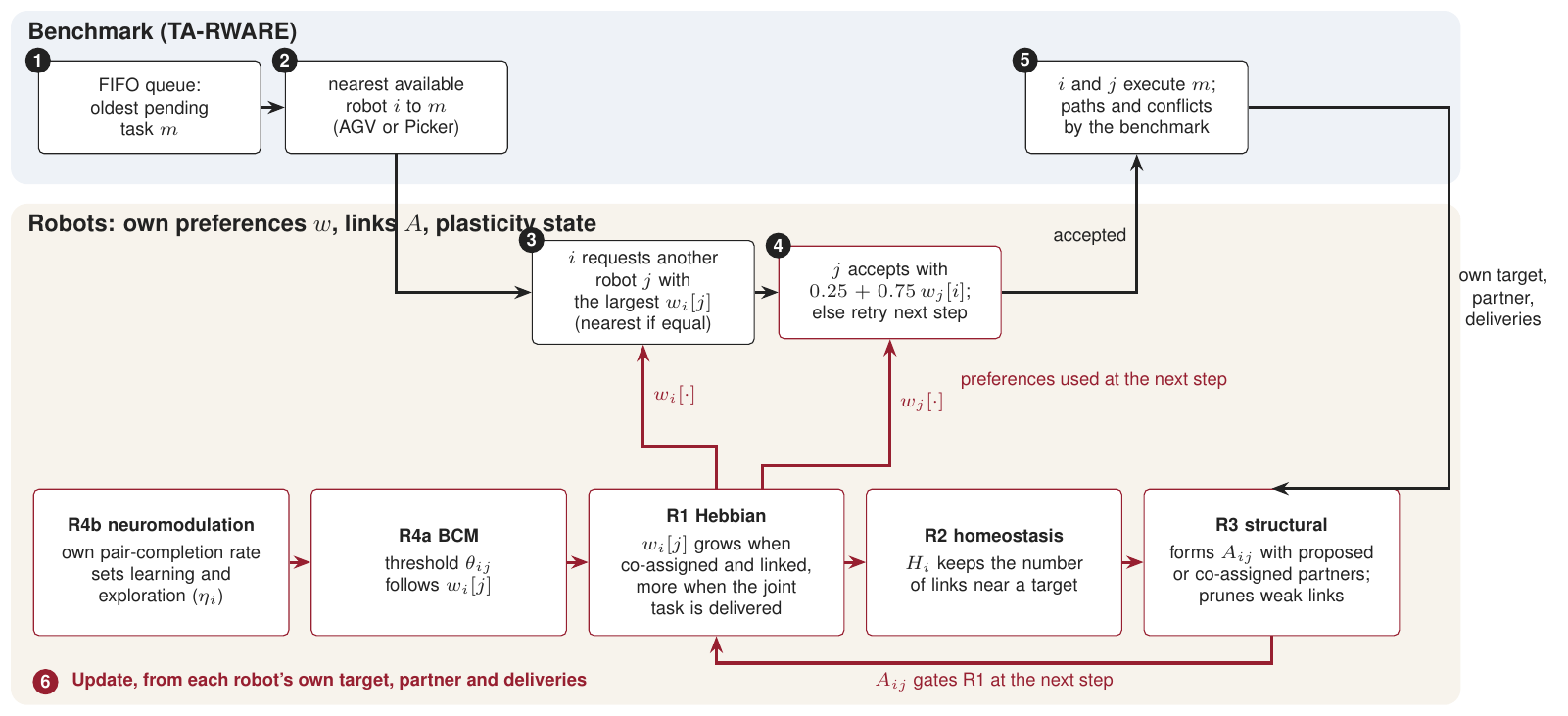
| Rule | What each robot does with its own preferences and links |
|---|---|
| R1 synaptic | Decay, plus strengthening in proportion to the share of recent targets shared with the partner; completion credit when a jointly served mission is delivered. |
| R2 homeostatic | Adjusts its readiness to form links so that its number of links stays near a target. |
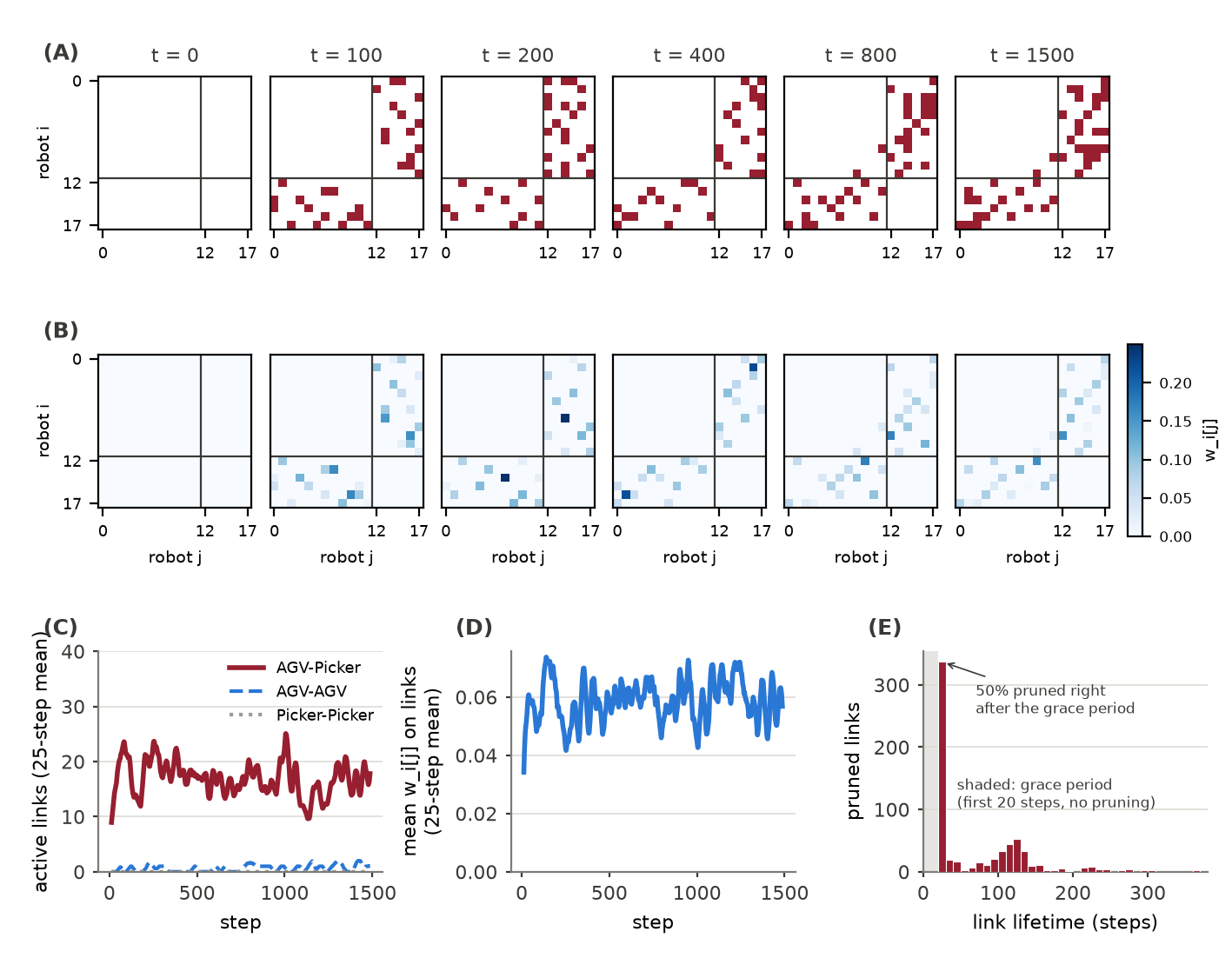
| R3 structural | Prunes weak links after a 20-step grace period; forms a link to its best candidate (recent co-assignment and the robot it was proposed). |
| R4 metaplastic | BCM-inspired sliding threshold (a preference above its own history decays faster) and neuromodulation from its own completed deliveries (learning rate and link-formation threshold). |
Scale study
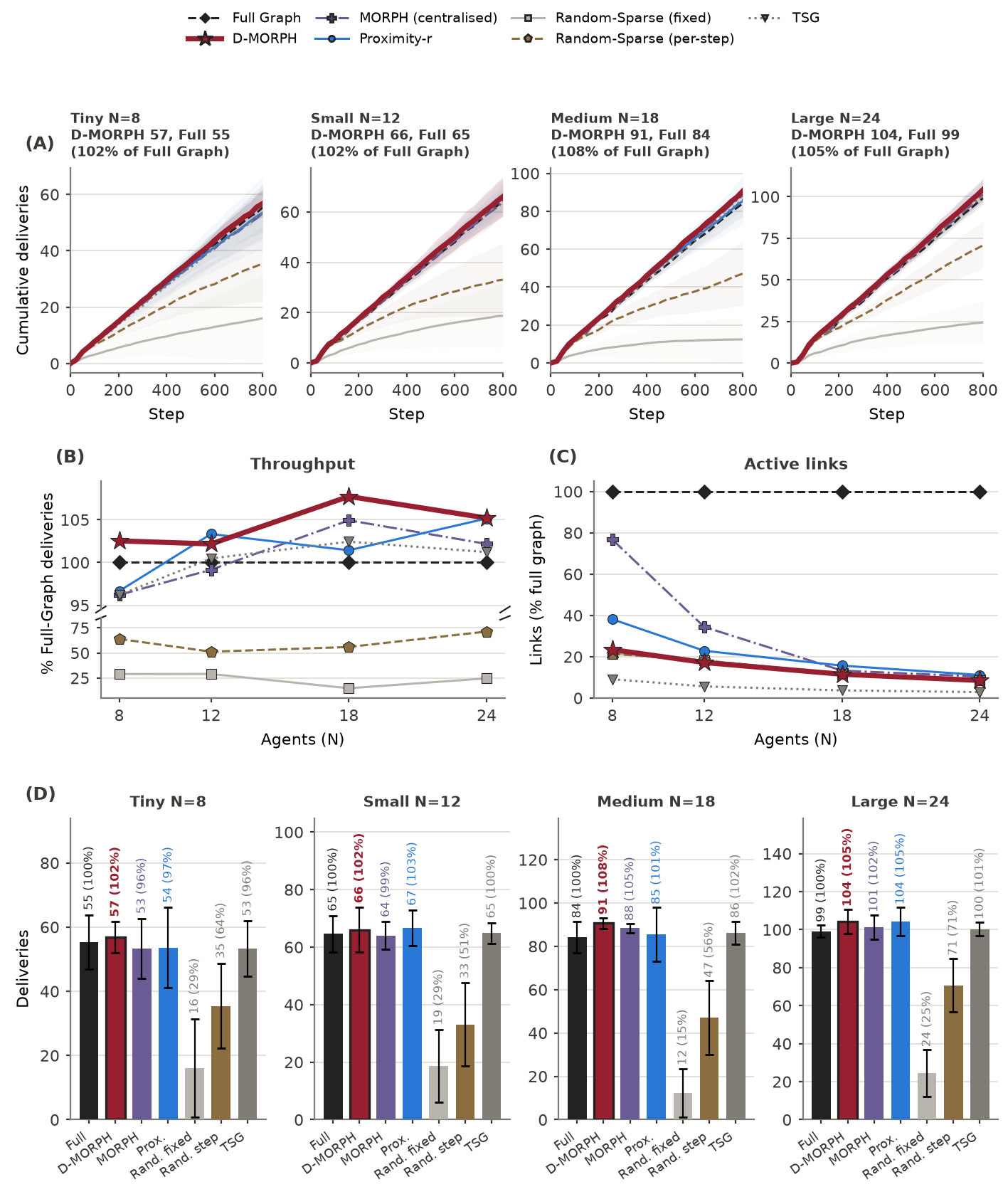
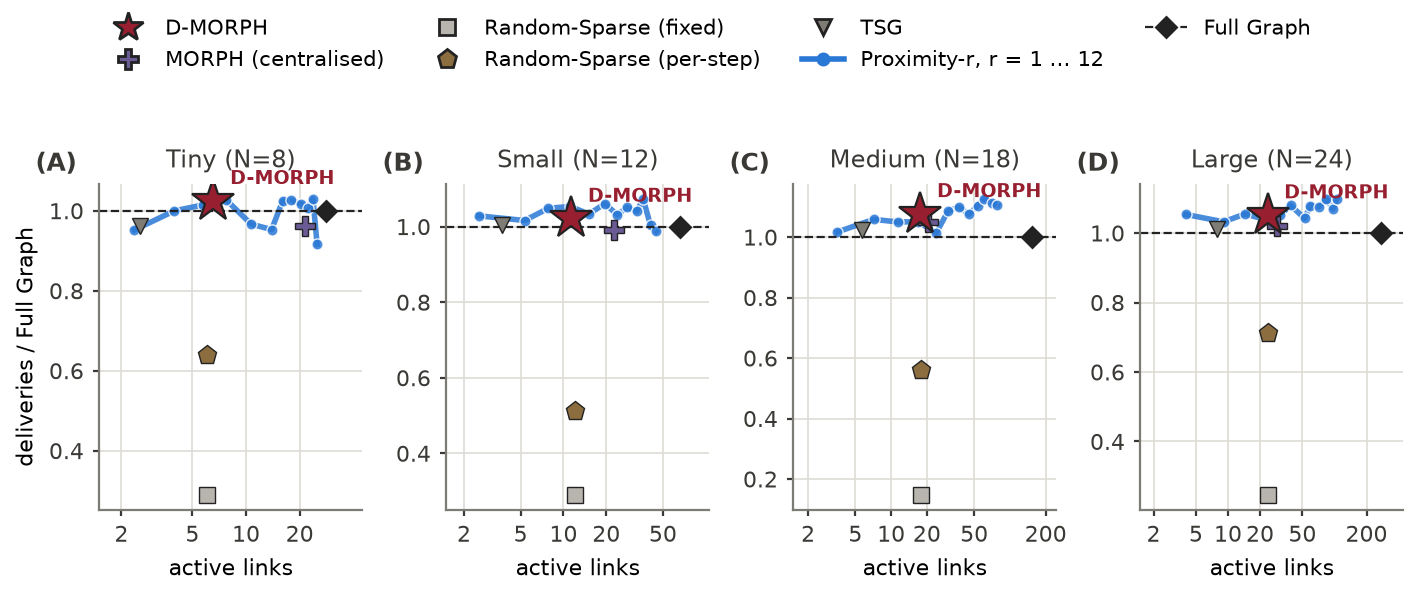
Seven methods, four fleet sizes, 20 seeds, 800 steps. Full Graph, MORPH, Proximity-r (r = 5) and TSG use MORPH's allocation loop; D-MORPH and both Random-Sparse variants use preference-based partner selection.
| Fleet | D-MORPH | Full Graph | MORPH | Proximity-r | TSG | Random-Sparse fixed / per-step | D-MORPH links (% of pairs) |
|---|---|---|---|---|---|---|---|
| Tiny (8) | 56.8 | 55.4 | 53.3 | 53.5 | 53.3 | 16.1 / 35.5 | 6.6 (23%) |
| Small (12) | 66.0 | 64.6 | 64.0 | 66.8 | 64.9 | 18.8 / 33.1 | 11.4 (17%) |
| Medium (18) | 90.7 | 84.2 | 88.3 | 85.4 | 86.2 | 12.4 / 47.1 | 17.6 (12%) |
| Large (24) | 104.3 | 99.2 | 101.3 | 104.2 | 100.3 | 24.4 / 70.8 | 23.5 (9%) |
Mean deliveries per episode. Paired two-sided Wilcoxon tests, p < 0.05 without correction for multiple comparisons: D-MORPH delivered significantly more than Full Graph at Medium (p = 0.0006) and Large (p = 0.0028) and more than MORPH at Medium (p = 0.0010); the differences at Tiny and Small are not significant.
Ablations
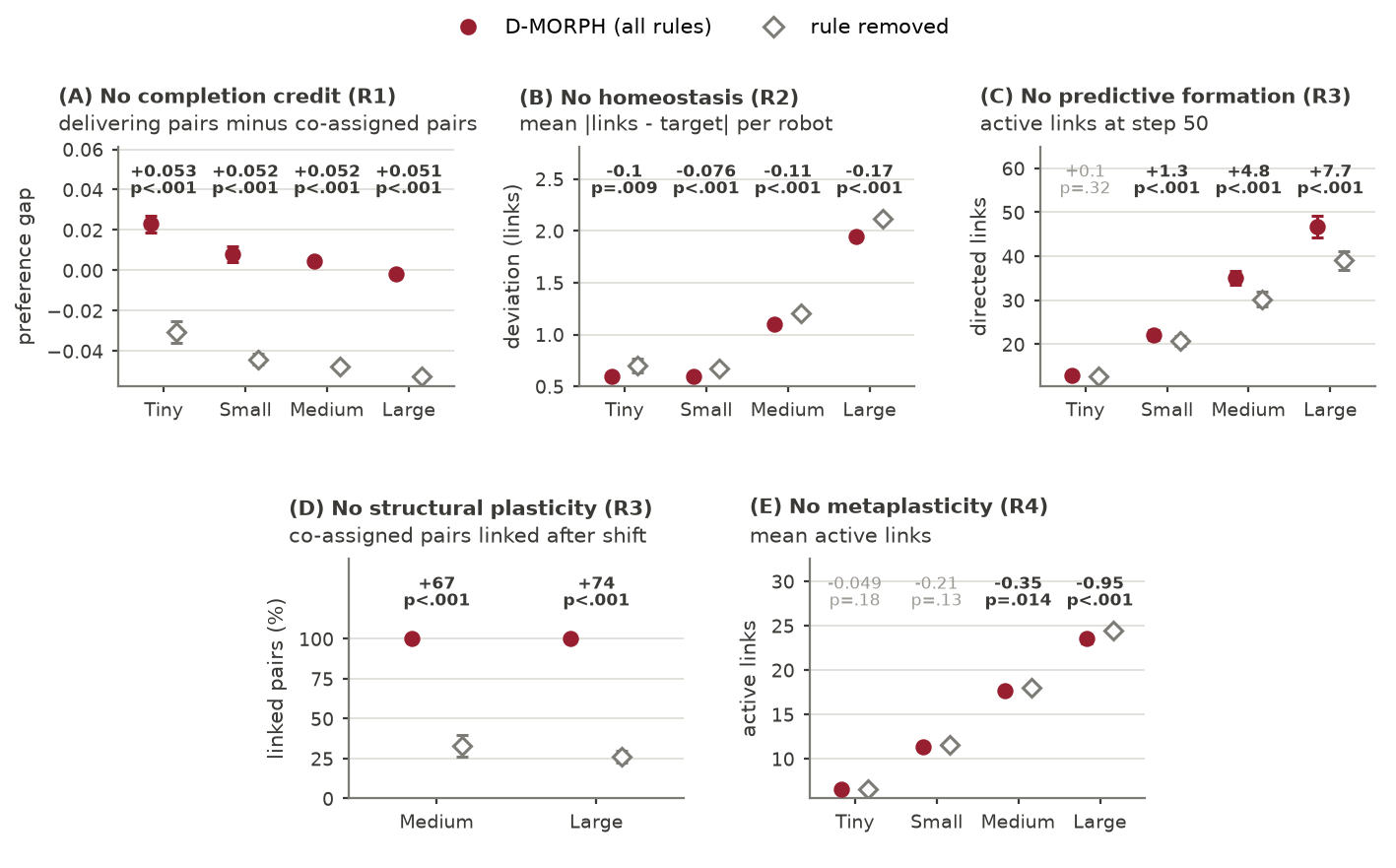
Each rule is removed in turn and compared with full D-MORPH on one measure fixed before the runs
(docs/ablation_hypotheses.md), with the same 20 seeds. Completion credit, homeostasis, predictive
formation and structural plasticity change their measures significantly; removing R4 (both parts) raises the
number of active links by 2% at Medium and 4% at Large. Deliveries do not change significantly in any scale-study
ablation; freezing the structure after step 400 lowers deliveries at Medium in the location shift (p = 0.022,
uncorrected). Deliveries for every ablation are in docs/tables/tableS1_ablation_deliveries.tex.
Package location shift
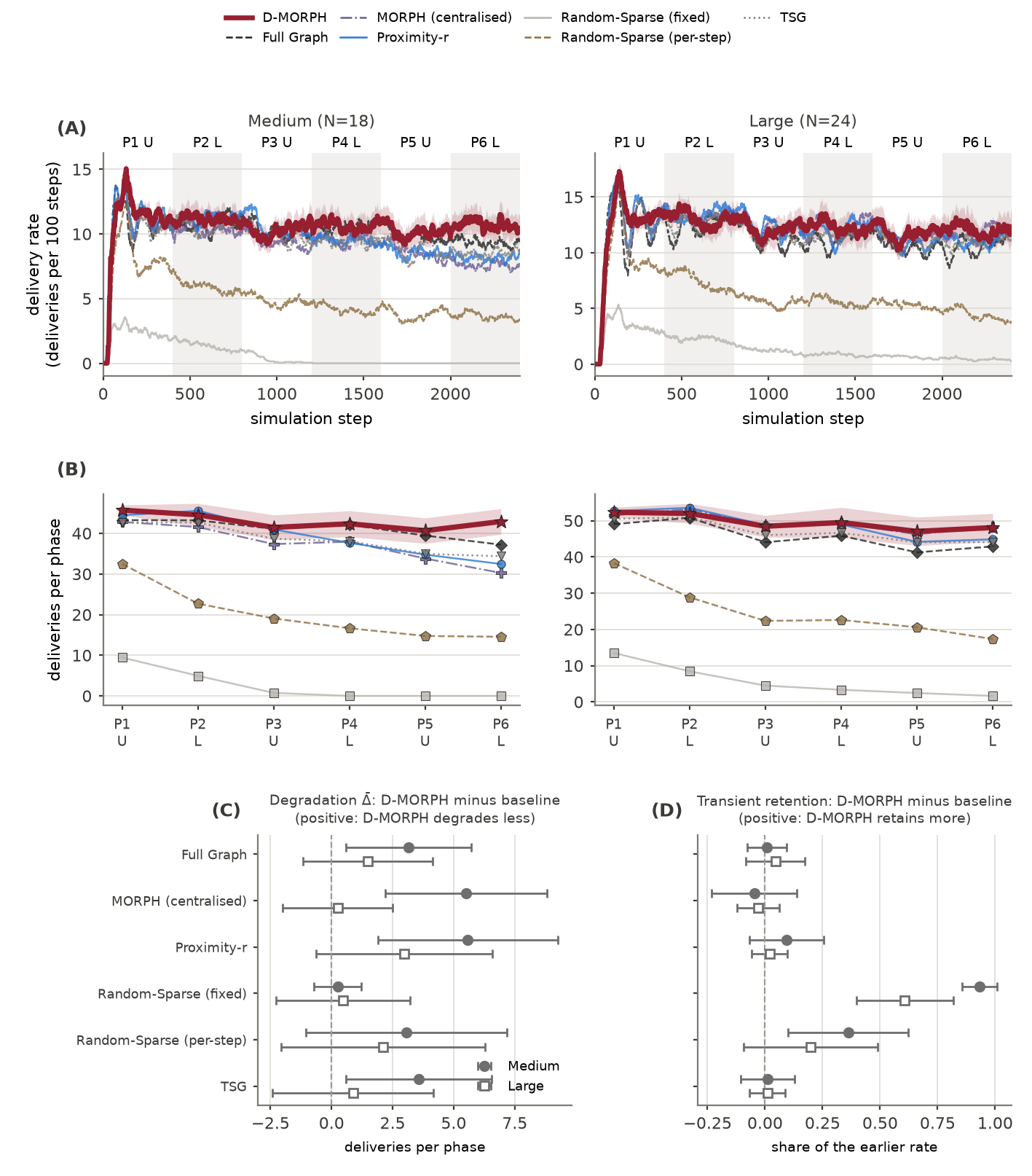
New requests come only from the upper (U) or the lower (L) half of the shelves, alternating every 400 steps over six phases (2400 steps), at Medium and Large. The delivery stations are on the lower edge.
Emergent allocation structure
Reproduce
pip install -r requirements.txt
python -m experiments.run all --jobs 16   # results/*.json, one file per experiment
python -m experiments.analysis            # docs/figures, docs/tables, docs/results.md
python scripts/make_videos.py             # docs/videos
Every episode is deterministic given its seed. To run D-MORPH in another benchmark or simulator, see Using D-MORPH in your own benchmark in the README.
Cite
@unpublished{niu2026dmorph,
  author = {Niu, Xuezhi and G{\"u}rd{\"u}r Broo, Didem},
  title  = {{D-MORPH}: Decentralised Self-Organising Multi-Robot Task Allocation
            via Neuroplasticity-Inspired Adaptive Topology},
  note   = {Manuscript},
  year   = {2026}
}